
Since the monarch population has dwindled in recent years, it was especially encouraging to see this one fluttering around on my Agastache.

What's different in my garden this year? For one, I planted Asclepias--widely known as Milkweed. Did you know that milkweed is The Only Plant that the monarch butterfly will lay its eggs on? Additionally, it's The Only Plant that the monarch larvae will eat!

My quest to have a monarch visit me started last year when garden writer/friend Cameron, of Defining Your Home, Garden and Travel, sent me some Asclepias incarnata (Swamp milkweed) seeds that she'd collected from plants in her garden. Unfortunately, the seeds did not germinate, as I saw no signs of them this spring. So in April of this year, I decided to order some live plants online, from Lazy S'S Farm, near Charlottesville, VA.

I was very impressed with the way the boxes were labeled so well on the outside, with a note to the mailman to please leave in a shady place to keep out of direct sun.

Not only that, but the plants were packed exceptionally well, making it virtually impossible for them to move around within the box, thereby remaining stable during shipment.
 |
| Asclepias incarnata (Swamp milkweed) |
 |
| Asclepias incarnata (Swamp milkweed) |
Some time in May or June, I added a few other varieties of Asclepias.
 |
| Asclepias exaltata (Poke milkweed a.k.a. Tall milkweed) |
 |
| Asclepias exaltata (Poke milkweed a.k.a.Tall milkweed) |
 |
| Asclepias purpurascens (Purple milkweed) |
A. variegata (below) was a sturdy plant but has not shown significant change or growth since it was planted.
 |
| Asclepias variegata (White milkweed) |
Also during the summer I purchased a couple of A. tuberosa from a local nursery. Known as Butterfly weed, its blooms came and went, before any monarch visitors had a chance to enjoy them.
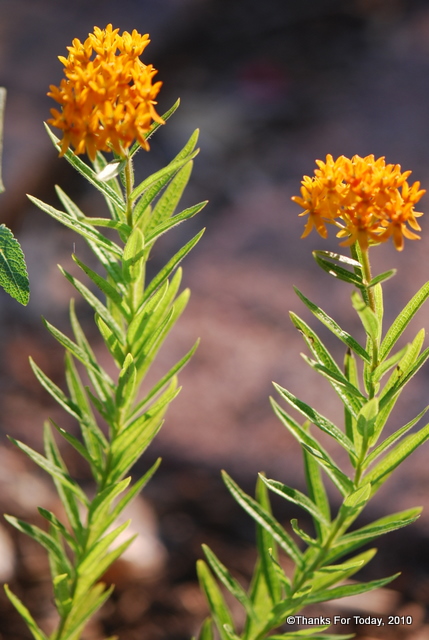 |
| Asclepias tuberosa (Butterfly Weed) |

What, you might ask, is on the stem of this A. incarnata (below), making it yellow?

The answer is Oleander aphids, also known as the Milkweed aphid. Since I don't use chemicals in the garden, I have frequently used the hose to spray a stream of water on them, trying to knock them off.

I don't recommend using a soap spray as even that will harm the monarch caterpillars, should any be developing there. I've even squished them by hand, from time to time--but there are so many of them, and they just keep coming back! The best thing is to use a quick blast of the hose. It won't hurt the plants and it will prevent the aphids from sucking the life out of your milkweed!

When I saw a ladybug last week I was hopeful there would be more, as they are natural predators to aphids. So far, though, lady bugs have been strangers to my garden this year:-(
My big hope now is that this monarch will lay eggs on my milkweed. Sure, the developing cats will eat the leaves and even the stems of the plants, but that's why I planted them in the first place.

Because natural habitats have been diminishing, it is important for as many gardeners as possible to add milkweed to their gardens.

You can visit Monarch Watch and learn about the Monarch Waystation Program. Every gardener is invited to participate and encourage monarchs to thrive!
There have been Swallowtail butterflies by the dozens this year, and believe me, I've been enjoying every minute of them! You can visit Swallowtail Butterfly Cats, My July Gardens, and August 2010: Garden Bloggers' Bloom Day to read about them. I'm hoping to be able to share photos of eggs, caterpillars and pupae of the monarch butterfly in a future post. I do hope it's not too late in the season!
Be sure to join Gail at Clay and Limestone for more natives on Wildflower Wednesday.
Today I am thankful for Milkweed and Monarchs:-)

Words and photos ©Thanks For Today, by Jan Huston Doble


